
- Business
- 소재 사업부
AT Materials
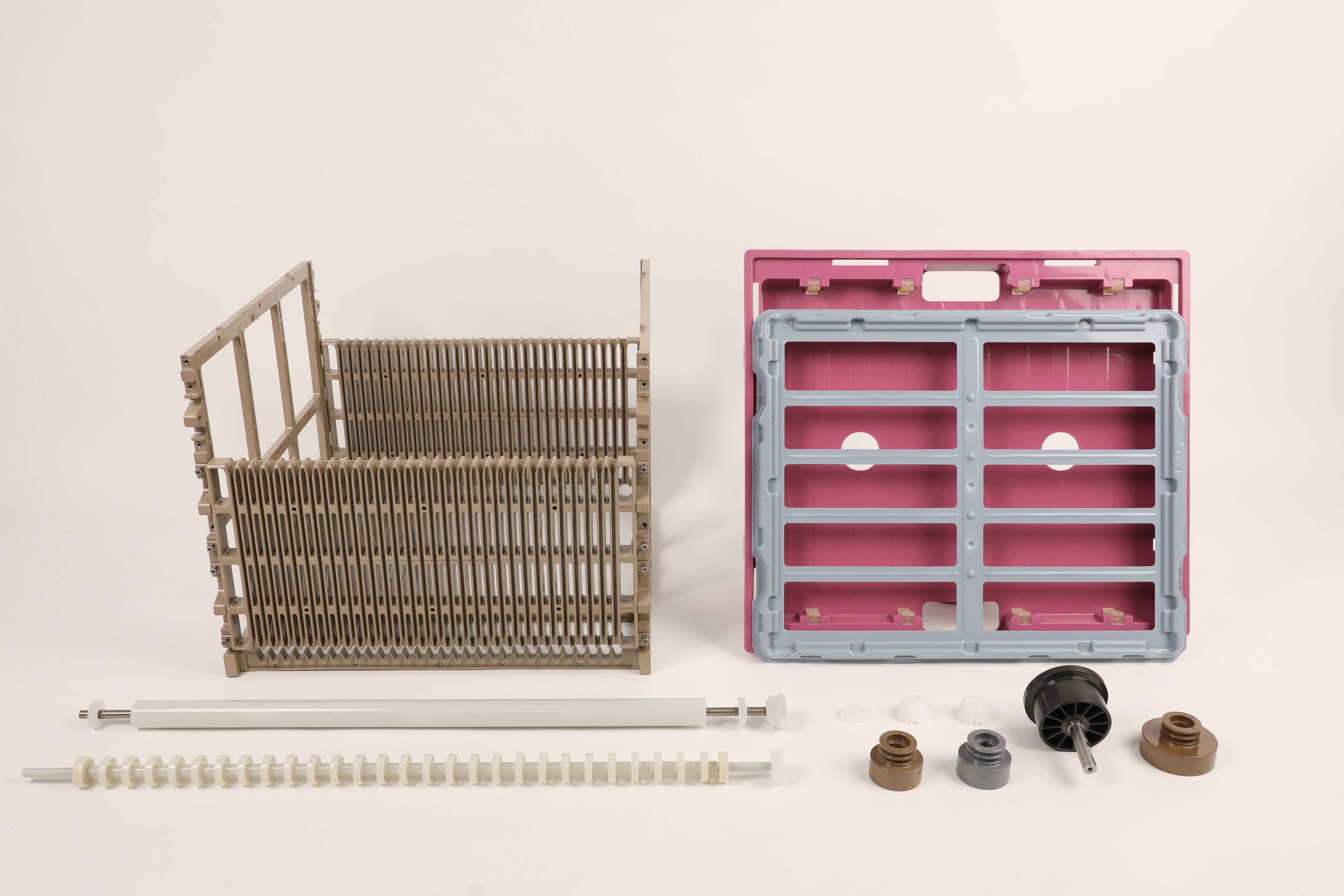
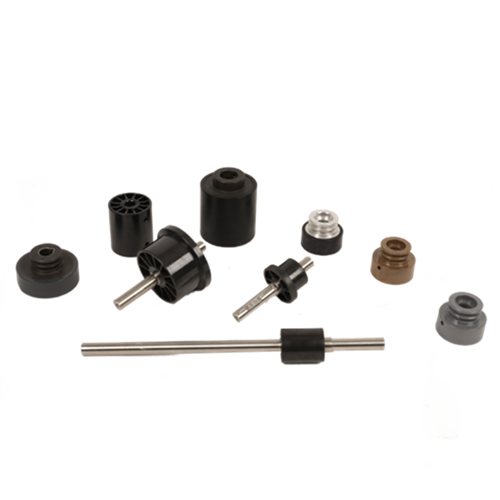
The AT material we developed improves upon the problems of existing synthetic resins and various plastics. Developed using high-hardness aramid and Teflon (PTFE) with excellent release properties, it boasts superior heat resistance, chemical resistance, and release properties compared to currently used materials like NPP, TPE (thermolyne), and PVDF.
| Item | Unit | PP | PEEK | PVDF | PTFE | AT-200 | AT-500 | AT-515S | AT-515I | AT-515C |
| Specific Gravity | - | 0.91 | 1.32 | 1.78 | 2.19 | 2.14 | 1.69 | 1.51 | 1.49 | 1.49 |
| Tensile Strength | MPa | 40 | 100 | 55 | 35 | 40 | 50 | 98.1 | 114 | 89.9 |
| Heat Deflection Temperature | °C | 65 | 160 | 120 | 60 | 71 | 76 | 198 | 187 | 198 |
| Impact Strength (Izod, Notched) | J/m | 40 | 55 | 160 | - | 775 | NB | 50 | 69 | 30 |
| Rockwell Hardness (HRR, Method A) | - | - | 75 | 90 | 80 | 60 | 65 | 90 | 114 | 120 |
| Surface Resistivity | Ω/□ | >1e15 | >1e13 | >1e13 | >1e17 | >1e13 | >1e13 | >1e13 | >1e13 | >1e6 |
| Abrasion Resistance (500 cycles / 1 kg) | mg | Pass | Pass | Pass | Pass | 41.6 | 25.5 | 13.7 | 29.7 | 28.3 |
| Test Item | Evaluation Criteria | AT-200 | AT-500 | AT-515S | AT-515I | AT-515C | Test Method |
| Acetone 99% | Appearance (cracks, discoloration, swelling) and weight change | No abnormality | No abnormality | No abnormality | No abnormality | No abnormality | KSM ISO 175:2010 (23°C, 72 hr) |
| Cyclohexane 99% | Same as above | No abnormality | No abnormality | No abnormality | No abnormality | No abnormality | KSM ISO 175:2010 (23°C, 72 hr) |
| Toluene 99% | Same as above | No abnormality | No abnormality | No abnormality | No abnormality | No abnormality | KSM ISO 175:2010 (60°C, 72 hr) |
| Ethanol 99% | Same as above | No abnormality | No abnormality | No abnormality | No abnormality | No abnormality | KSM ISO 175:2010 (60°C, 72 hr) |
| Sulfuric Acid 30% | Same as above | No abnormality | No abnormality | No abnormality | No abnormality | No abnormality | KSM ISO 175:2010 (60°C, 72 hr) |
| Hydrochloric Acid 30% | Same as above | No abnormality | No abnormality | No abnormality | No abnormality | No abnormality | KSM ISO 175:2010 (60°C, 72 hr) |
| Nitric Acid 40% | Same as above | No abnormality | No abnormality | No abnormality | No abnormality | No abnormality | KSM ISO 175:2010 (60°C, 72 hr) |
| Formic Acid 85% | Same as above | No abnormality | No abnormality | No abnormality | No abnormality | No abnormality | KSM ISO 175:2010 (60°C, 72 hr) |
| Permanganic Acid 75% | Same as above | No abnormality | No abnormality | No abnormality | No abnormality | No abnormality | KSM ISO 175:2010 (60°C, 72 hr) |
| Sodium Hydroxide 25% | Same as above | No abnormality | No abnormality | No abnormality | No abnormality | No abnormality | KSM ISO 175:2010 (60°C, 72 hr) |


(16676) 244 Sinwon-ro, Yeongtong-gu, Suwon-si, Gyeonggi-do
TEL : +82 31-273-8400~8402 FAX : +82 31-273-8403 E-MAIL : ant@e-ant.co.kr
Copyright ⓒ ANT. All rights reserved.

Through the privacy policy, the company informs you of the purpose and method of use of the personal information you provide, and what measures are being taken to protect your personal information.
- Self-identification, real name verification, confirmation of subscription intent, use of age
- restricted services according to service use
- Contract performance regarding service provision and fee settlement, content provision, purchase and fee payment, product delivery or sending of invoices, etc.
- Delivery of notices, securing communication channels for complaint handling, securing accurate delivery information when delivering products
- Information for providing the latest information such as new services and providing personalized services
- Other smooth provision of high-quality services, etc.
- Name, company name, email, address, contact information, mobile phone number, inquiry content, and other optional items
- In principle, personal information is destroyed without delay upon achieving the purpose of collection or provision.
- However, in order to provide smooth service consultation, the contents may be retained for 3 months after the consultation is completed, and in cases where preservation is required by other laws such as the Act on Consumer Protection in Electronic Commerce, the information will be retained for a certain period of time.
In principle, the company destroys the relevant information without delay after the purpose of collecting and using personal information has been achieved. The information you entered for membership registration, etc. is transferred to a separate DB (separate file in the case of paper) after the purpose has been achieved, and stored for a certain period of time according to internal policies and other relevant laws and regulations for information protection reasons (see retention and use period) and then destroyed. Personal information transferred to a separate DB will not be used for any other purpose than that for which it is retained, unless required by law. Personal information stored in electronic file format is deleted using a technical method that makes it impossible to reproduce the record.
본 웹사이트에 게시된 이메일 주소가 전자우편수집 프로그램이나그밖의 기술적장치를 이용하여 무단으로 수집되는 것을 거부하며 이를 위반시 정보통신망 이용촉진 및 정보보호등에 관한 법률에 의해처벌 받을 수 있습니다.